In the proceedings of Ergonomics and Human Factors 2026: Adversarial Design Thinking.
THE POSTER
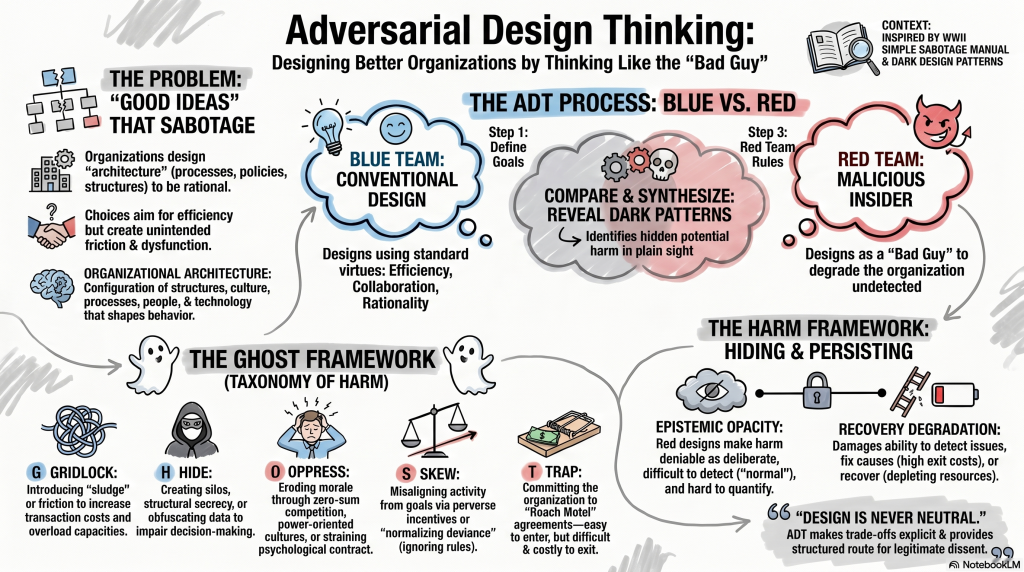
THE ABSTRACT
Organisations can unintentionally create friction, dysfunction, and harm through the design of their structures, processes, and information flows. This paper introduces Adversarial Design Thinking, a parallel‐design method that applies a malicious‐insider mindset to organisational architecture to reveal these hidden vulnerabilities. A Red Team is tasked to design solutions that meet stated goals while maximising plausible, undetected organisational harm, while a Blue Team designs conventionally. Comparing their outputs surfaces latent risks, structural weaknesses, and unintended consequences that human‐centred approaches—often assuming good intent—may overlook. The paper presents the GHOST and Harm frameworks to support identification of adversarial design patterns, showing how organisational features can hide harm, degrade recovery, and allow dysfunction to accumulate. This lens strengthens organisational resilience and design quality.
